
Before You Board: A Practical Guide to Medical Coverage for International Travel
A medical emergency abroad can cost $50,000 before the first flight home. Here's what your current medical insurance actually covers — and how to close the gaps.
A client called me from London two years ago. He'd collapsed at dinner, been taken by ambulance to a private hospital, and was facing a bill north of £18,000 before anyone discussed what to do next. His domestic health plan covered essentially nothing. He had no travel insurance. He paid out of pocket, flew home first class under medical supervision, and spent the next three months sorting out a reimbursement claim that ultimately recovered about 30 cents on the dollar.
He travels internationally six or seven times a year. It was the first time anything had gone wrong. And he was completely unprepared.
That story is more common than you might expect — and more avoidable than it was for him. The world has excellent medical facilities in most major cities. The problem is rarely the quality of care; it's the cost, the logistics, and the insurance gap that most Americans don't discover until they're in it.
Here's what you actually need to know before your next international trip.
"The two most expensive medical events for international travelers are: a hospital stay they weren't expecting, and an evacuation they didn't know they needed."
Does Your Domestic Health Insurance Cover You Abroad?
The short answer: usually not well, and sometimes not at all.
Most U.S. employer-sponsored health plans are designed around domestic provider networks. When you're treated abroad, you're automatically out-of-network — and many plans explicitly exclude or severely limit coverage for international medical expenses. Even plans that technically cover international emergencies often require you to pay in full at the point of care (in the local currency), then file a reimbursement claim in the U.S. — a process that can take months and frequently recovers less than the full amount.
Routine care, prescription refills, non-emergency treatment, and anything that doesn't meet the plan's narrow definition of "emergency" is typically not covered at all. Dental emergencies abroad almost never qualify. Mental health care rarely does.
The practical reality: treat your domestic health plan as providing zero coverage internationally, and plan accordingly. If it turns out to cover something, consider it a pleasant surprise.
What About Medicare?
Medicare's international coverage is straightforward: with very limited exceptions, Original Medicare (Parts A and B) does not cover medical care outside the United States.
The exceptions are narrow — primarily situations where a foreign hospital is closer to you than a U.S. hospital (relevant mainly in border regions of Canada and Mexico), or where you're on a ship within six hours of a U.S. port. For the typical PAM client traveling to Europe, Asia, Latin America, or elsewhere, these exceptions are irrelevant.
Medicare Advantage plans vary, but most offer only limited emergency coverage abroad, and none provide comprehensive international coverage.
Medicare Supplement (Medigap) — The One Exception Worth Knowing
Medigap Plans C, D, F, G, M, and N include a foreign travel emergency benefit. Coverage kicks in after a $250 deductible and covers 80% of eligible emergency medical expenses abroad — up to a $50,000 lifetime limit.
For clients on Medicare, this is better than nothing — but the $50,000 lifetime limit is a real ceiling. A complex hospitalization in a major European city, followed by medical evacuation home, can exceed that figure without difficulty.
The Medigap foreign travel benefit covers emergencies only. It does not cover planned procedures, routine care, evacuation coordination, or non-emergency hospitalization. It is a floor, not a plan.
The Options: What International Coverage Actually Looks Like
The good news: the travel insurance market is mature, competitive, and reasonably priced — particularly for frequent travelers. Here are the main categories and what each actually provides:
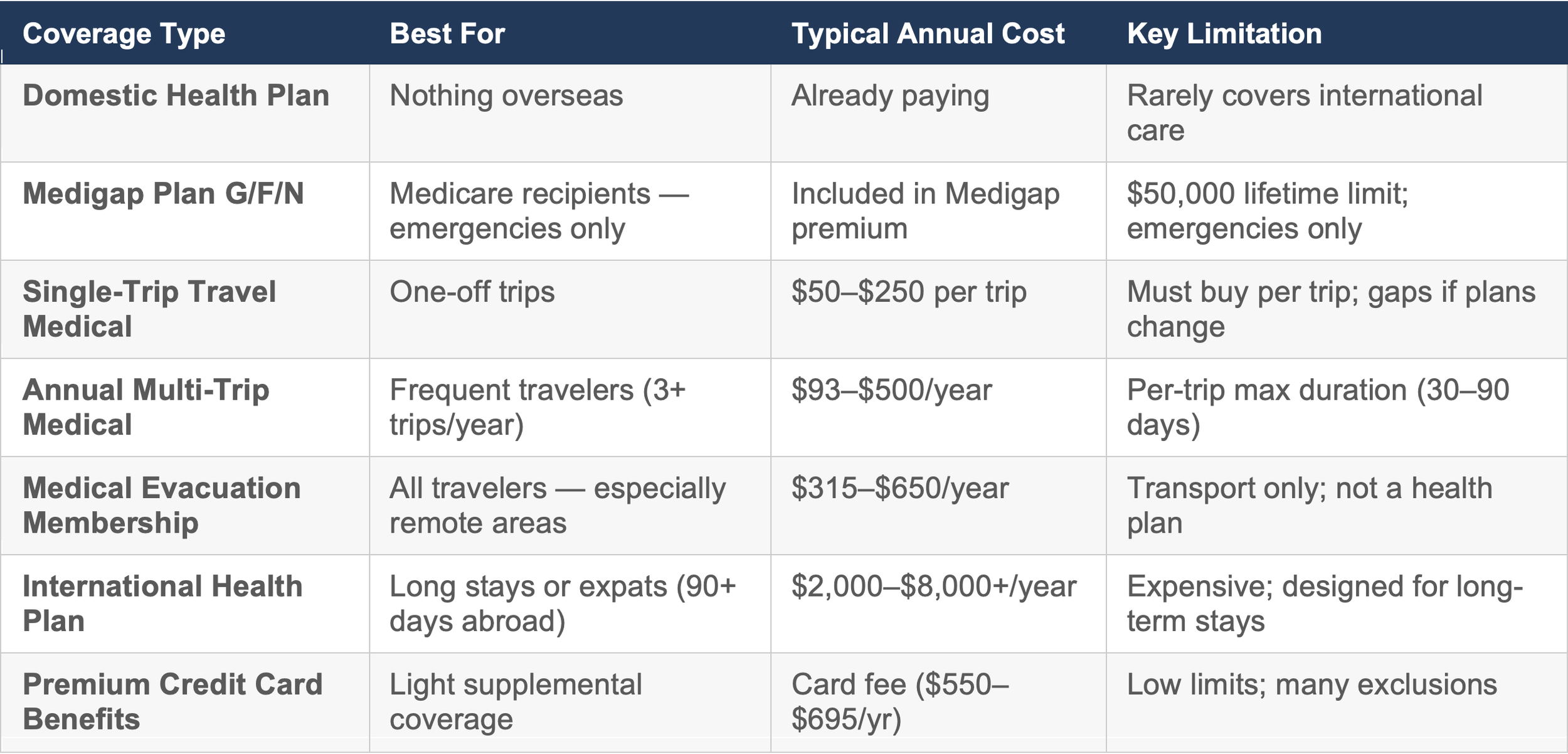
Costs are approximate ranges for 2026. Individual pricing depends on age, trip duration, coverage limits, and destination. Always verify specific plan terms before purchasing.
For PAM clients who travel internationally three or more times per year, an annual multi-trip plan combined with a medical evacuation membership is typically the most cost-effective and comprehensive solution. Here's how each piece works:
Annual Multi-Trip Travel Medical Insurance.
Plans like GeoBlue Trekker, IMG Global Medical, and similar products provide $1 million or more in emergency medical coverage per trip, for unlimited trips throughout the year (with each trip typically capped at 30, 45, or 70 days). Annual premiums range from approximately $200–$500 for individual coverage, depending on age and plan. These plans handle the medical bills — hospitalization, surgery, physician fees, prescription drugs, and emergency dental.
Medical Evacuation Memberships — the piece most people miss.
A travel medical plan pays your bills at a foreign hospital. It doesn't necessarily get you home. Medical evacuation — the coordination, transportation, and logistics of moving a patient from a foreign hospital to a U.S. facility — is a separate, expensive service. Without a dedicated evacuation membership, you're looking at costs of $25,000 to $250,000+ depending on distance and complexity.
Two of the leading providers:
● Global Rescue — $375/year for individuals, $670 for families. Provides field rescue, medical evacuation, and transport to the hospital of your choice in the U.S. Known for operating in remote and conflict-adjacent areas.
● Medjet Assist — $315/year (base) to $474/year (Horizon plan) for individuals. Focuses on hospital-to-hospital transport for members hospitalized 150+ miles from home. More domestic-friendly; slightly narrower remote-area coverage than Global Rescue.
For clients who travel to urban destinations in developed countries, either plan is excellent. For clients who hike, visit remote areas, or travel to developing regions with limited medical infrastructure, Global Rescue's broader field rescue capability is worth the modest premium difference.
Premium Credit Card Benefits — useful but not sufficient.
Cards like the Amex Platinum and Chase Sapphire Reserve include some travel insurance benefits — typically trip cancellation, trip delay, lost luggage, and modest emergency medical coverage. These are genuine benefits, but their medical coverage limits are low ($10,000–$50,000), their definitions of emergency are narrow, and they do not include medical evacuation. Treat card benefits as supplemental, not primary.
Where the Risk Is Higher: Destinations That Warrant Extra Planning
Medical risk isn't uniform across the globe. The U.S. State Department rates every country on a four-level advisory system — and the level matters directly to your insurance planning, because some policies exclude or limit coverage in Level 3 and 4 countries.
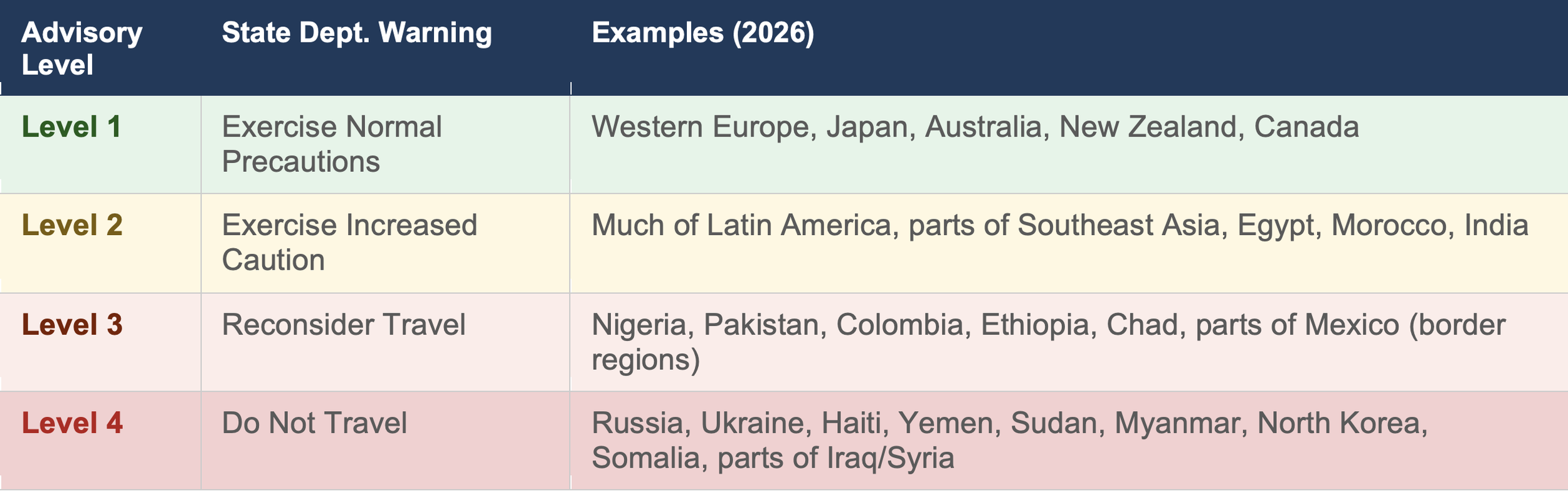
State Department advisory levels as of August 2026. Levels can change. Check travel.state.gov before every international trip.
Beyond the advisory level, several specific risk factors are worth checking before any international trip:
● Medical infrastructure quality. Major cities in Europe, Japan, Singapore, Australia, and Canada have world-class hospitals. Remote areas in Sub-Saharan Africa, Central Asia, and parts of Latin America may have limited facilities — making evacuation coverage more critical, not less.
● Disease risk. Some destinations require or strongly recommend vaccinations (yellow fever, typhoid, hepatitis A/B, meningitis). Malaria prophylaxis is advisable for parts of Africa, Southeast Asia, and Central America. Consult a travel medicine clinic 4–6 weeks before departure.
● Policy exclusions. Many travel insurance policies exclude coverage in countries under a Level 4 advisory or active conflict zones. Read the fine print — or better, call and confirm — before traveling to higher-risk areas.
● Medication access. Prescription medications may not be available abroad under their U.S. names. Carry a 30-day supply plus a letter from your physician describing your medications and their generic names. Some countries classify common U.S. medications as controlled substances.
Five Things to Do Before Every International Trip
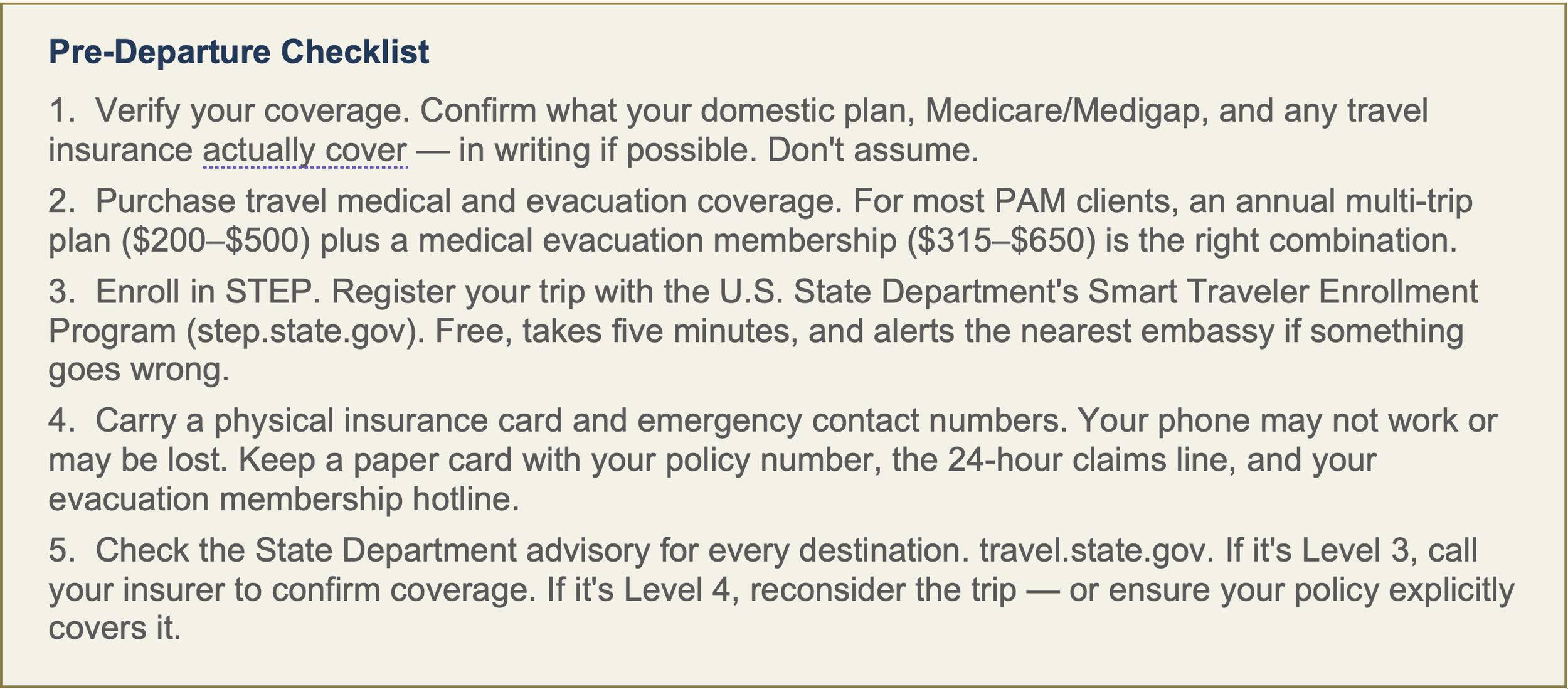
If Something Goes Wrong: The First 60 Minutes
Planning and coverage matter enormously. So does knowing what to do in the moment.
The most common mistake in an international medical emergency isn't a coverage gap — it's the panic-driven assumption that help works the same way it does at home. It doesn't. 911 is a U.S. and Canadian number. In most of the world, it connects to nothing. Dialing it in Tokyo, Paris, or São Paulo will not summon an ambulance.
The number to call — and what happens when you call it — varies by country. Memorize it or save it before you land.
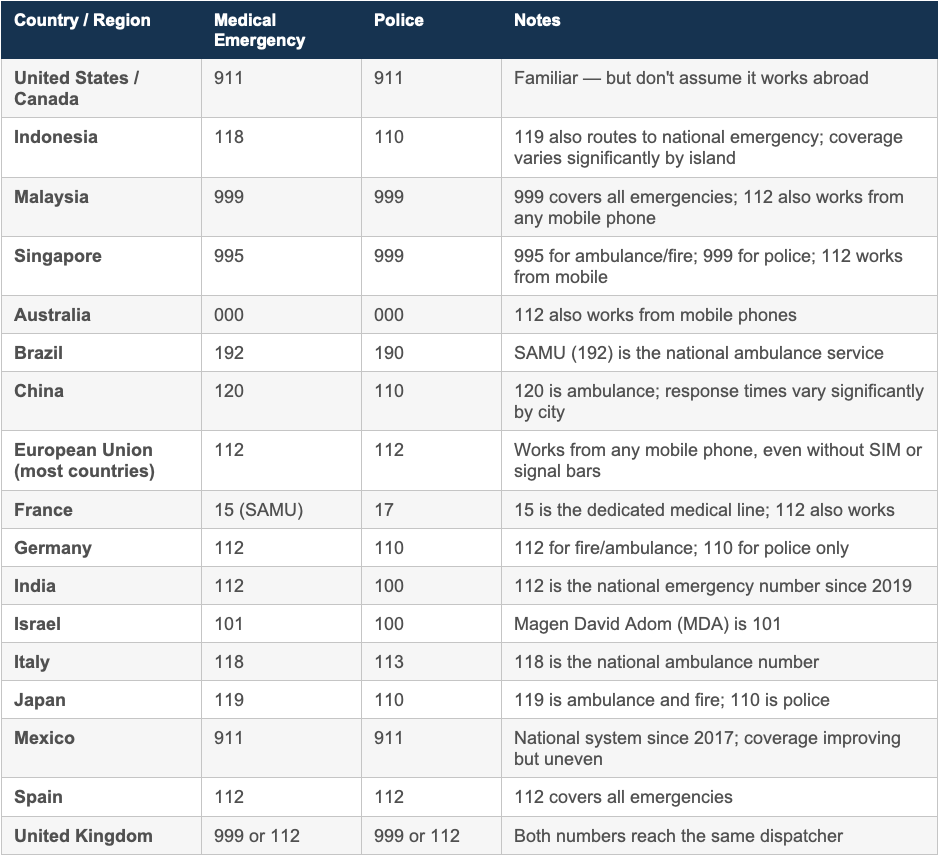
Emergency numbers are subject to change. Verify with your hotel or destination country's official resources. In most of Europe, 112 is the universal mobile emergency number and is the safest default.
Beyond calling for help, the first 60 minutes matter for two other decisions most travelers haven't thought through:
Call your evacuation membership immediately — not after you're admitted.
This is the step people consistently miss. Once you've stabilized and are admitted to a foreign hospital, your evacuation provider's options narrow. Many evacuation memberships require that transport be arranged before you're formally admitted to a facility, or they retain the right to determine whether your condition meets the threshold for evacuation. Call Global Rescue or Medjet the moment you know you're dealing with something serious — before the hospital admission paperwork is signed. They have 24-hour hotlines staffed by medical professionals who will guide you through the process.
Know where you want to be treated.
This is a question worth answering before the emergency, not during it. If you're hospitalized abroad and your condition is stable enough to transport, evacuation services will typically ask: where do you want to go? The answer matters. Global Rescue, for example, will transport members to "the hospital of their choice" in their home country — not necessarily the nearest hospital. That means you could specify your own health system, your own physicians, the institution that holds your medical records.
Have that answer ready. Write it on the back of your insurance card: the name of your preferred hospital and a physician's name and phone number. When you're the one in the hospital bed, you won't be in a position to research options.
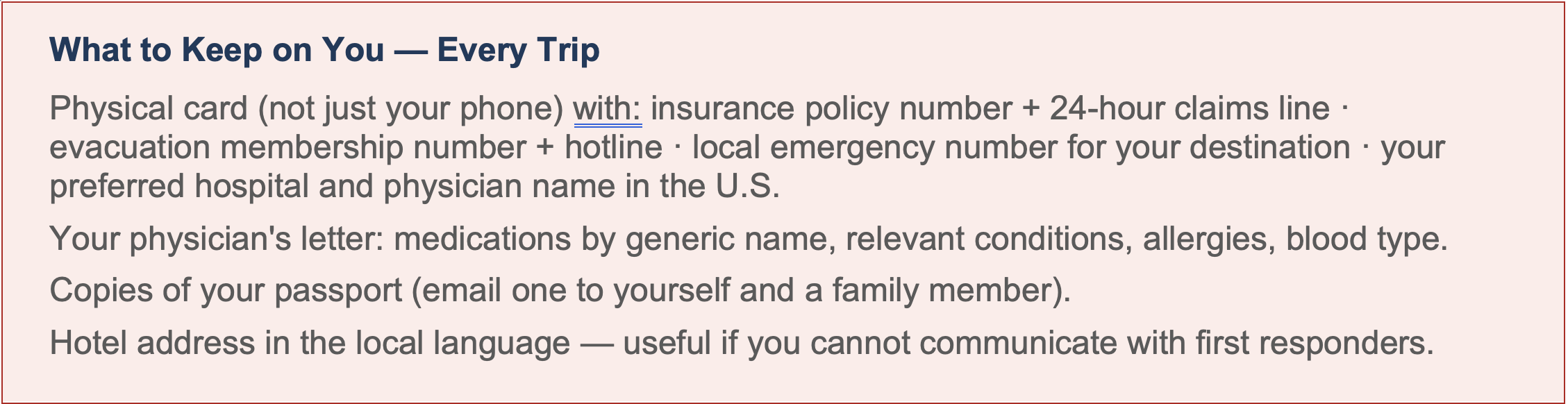
What to Keep on You — Every Trip
Physical card (not just your phone) with: insurance policy number + 24-hour claims line · evacuation membership number + hotline · local emergency number for your destination · your preferred hospital and physician name in the U.S.
Your physician's letter: medications by generic name, relevant conditions, allergies, blood type.
Copies of your passport (email one to yourself and a family member).
Hotel address in the local language — useful if you cannot communicate with first responders.
A Note on Cost — and Perspective
The cost of comprehensive international coverage for a frequent traveler — annual medical plan plus evacuation membership — runs approximately $500–$1,200 per year. For someone taking six international trips, that's roughly $100 per trip, or less than the cost of a single checked bag on a transatlantic flight.
The cost of being uninsured and needing care: a straightforward hospitalization in a European private hospital runs $10,000–$50,000. A complex case with evacuation home can reach $200,000 or more. Medical bills of this size have a way of becoming financial events, not just health events.
For most of our clients, the dollar amounts involved aren't the primary concern. The real value of having proper coverage is simpler: it means that if something goes wrong in Tokyo or Lisbon or Nairobi, the only conversation you're having is about getting better — not about who's paying.
Questions about your coverage before your next trip?
mike@privateasset.com | privateasset.com | Kirkland, WA
Mike Thayer is President of Private Asset Management, Inc., a registered investment adviser in Kirkland, Washington. This post is for informational purposes only and does not constitute insurance advice. Coverage terms, costs, and availability vary by provider, age, destination, and individual circumstances. PAM is not an insurance broker and does not sell insurance products. Clients should consult a licensed insurance professional before purchasing any travel or health insurance product. State Department advisory levels are subject to change — verify at travel.state.gov before departure.