When Your Tech Stock Has Become Your Entire Financial Plan
I had a conversation recently with a client who had worked at a major Puget Sound technology company for sixteen years. He'd accumulated a significant position — through stock grants, company match in his 401(k), and shares he'd bought in the early days because he believed in the company. The stock had been extraordinary. He was, by most measures, very wealthy.
He was also sitting with more than 70% of his net worth in a single stock. And he knew, intellectually, that this was a problem. The emotional math was harder.
"I know I should diversify," he told me. "But every time I think about selling, it goes up."
That feeling is nearly universal among people in his position. It's also one of the most dangerous biases in personal finance. Let me explain why — and what the actual options look like.
"Concentrated positions create wealth. Diversification protects it. The job of financial planning is to help you do both without flinching at either."
What Concentration Risk Actually Means
Concentration risk is the risk that a disproportionately large portion of your financial life is tied to the performance of a single security. It sounds clinical. The real-world version is this: if your company's stock drops 40% — for any reason, including reasons that have nothing to do with the company's actual quality — your net worth drops 28%.
That's not a hypothetical. It's what happened to Microsoft in 2022. It recovered. But the recovery took time, and the emotional and financial cost of that period was real. It happens to every major company eventually, and the drops are rarely predictable.
The Puget Sound is full of people who have experienced the upside of concentration — real wealth created through company equity, loyalty, and good timing. It is also full of people who have lived through what happens when concentration meets a bad year. Both experiences tend to live in the same people.
The Emotional Challenge Nobody Warns You About
Here's what the financial planning literature doesn't say clearly enough: selling a stock that has made you wealthy feels wrong in a way that goes beyond rational analysis. The stock represents years of work. It's the proof that you made a good decision. Selling it feels like abandoning something that's been loyal to you.
That feeling doesn't make you irrational. It makes you human. But it does mean that concentration decisions rarely get made on their own — they either get forced (by a financial need, a tax event, or a market drop) or they get planned deliberately, before the emotion kicks in.
The clients I've seen navigate concentrated positions best are the ones who made a plan before they needed one. Not in a crisis, not in response to a bad quarter — but when everything was good and they could think clearly.
The Options, Plainly Described
There is no single right answer for managing a concentrated position. There are tradeoffs, and the right tradeoffs depend on your timeline, your tax situation, your income, and your estate picture. Here's how I explain the main approaches:
Staged Diversification — the most common starting point.
Rather than selling all at once, you sell a portion of the position each year — a common approach is 10–20% annually over 5–10 years. You capture the ongoing upside while systematically reducing exposure. It's rational in principle, but a flat fixed-percentage plan has a meaningful flaw: it sells the same amount whether the stock is at an all-time high or down 25% for the year. Market conditions matter, and a static plan ignores them.
PAM's Approach: The CEDAR Framework — a dynamic alternative.
For clients with significant concentrated positions, PAM has developed a proprietary planning framework called CEDAR — Concentrated Equity Diversification and Retirement. CEDAR starts where staged diversification ends and makes it significantly more sophisticated.
The framework is built around two inputs: a target divestment date (when you want to be substantially diversified) and a price-responsive mechanism that automatically adjusts the pace of sales based on how the stock is performing. The target date holds — CEDAR simply determines how you get there.
↑ STOCK PRICE RISES
CEDAR Accelerates
Sells above the baseline pace for that period. The position has grown in value and concentration has increased — this is the right moment to take gains.
Logic: sell more when it's working for you.
↓ STOCK PRICE FALLS
CEDAR Decelerates
Sells below the baseline pace for that period. Selling into weakness locks in losses and reduces the long-term average sale price.
Logic: patience preserves value; the target date holds.
The result is a plan that behaves the way a disciplined investor would: selling more aggressively when conditions favor it and exercising patience when they don't — all without requiring an emotional decision in the moment. The rules are set in advance. The execution is systematic.
How it works in practice.
CEDAR establishes a baseline annual sale amount — the straight-line pace needed to reach your diversification target by your chosen date. Each period, a price threshold determines whether you're in an accelerate, hold, or decelerate state. Sales happen according to the plan, not according to how the market feels that week.
The hypothetical below illustrates the difference between a flat 10%-per-year approach and CEDAR over a five-year window, using a $1M starting position:
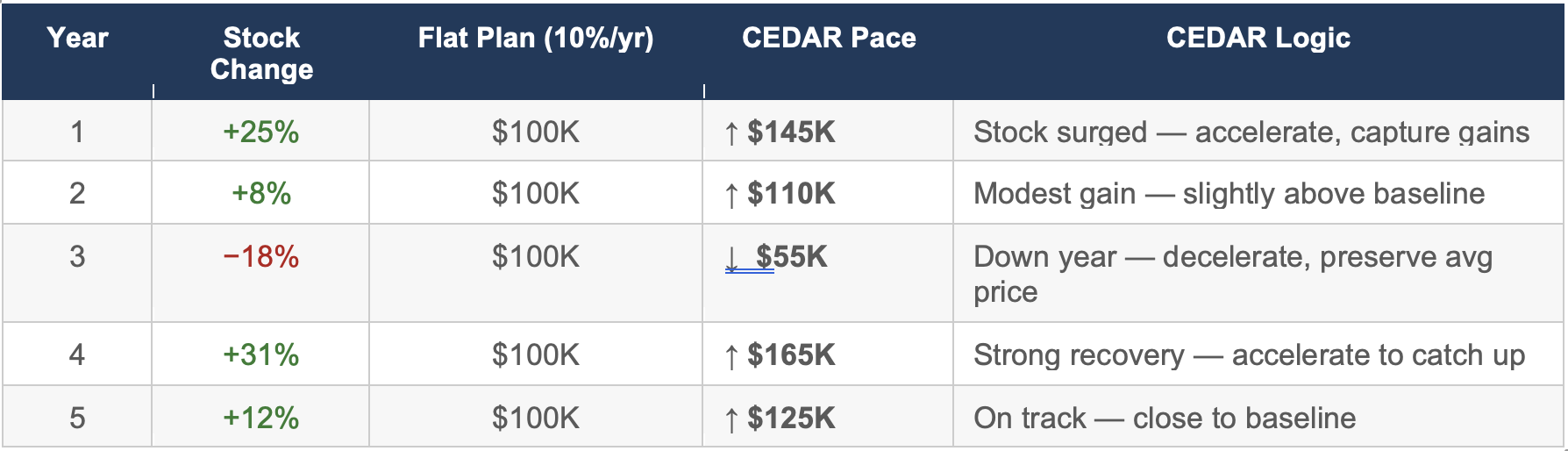
Hypothetical illustration only. Actual results will vary. The CEDAR framework is PAM's proprietary approach and is customized to each client's timeline, position size, and tax situation.
Notice what CEDAR does in year 3: when the stock drops 18%, it slows down — protecting the average sale price over the full plan. In years 1 and 4, when the stock surges, it accelerates — capturing those gains before they reverse. The flat plan treats every year identically. CEDAR responds to reality.
Over a full market cycle, the dynamic approach tends to produce a higher average sale price than a fixed-percentage plan — and it has a secondary benefit that matters more than most clients expect: it's emotionally easier to execute. Selling more when the stock is up feels good. Selling less when it's down feels prudent. The plan aligns with your instincts rather than fighting them.
CEDAR Is Customized to You
Target date: Retirement, a business sale, a child's college start, or any horizon that anchors your plan.
Position size and cost basis: Determines the baseline pace and tax sequencing across the plan.
Price thresholds: Set based on the stock's historical volatility and your concentration tolerance.
Tax coordination: CEDAR sequences sales across tax years and coordinates with your CPA on lot selection, capital gains tax, and charitable giving opportunities.
Estate integration: The plan accounts for WA estate tax exposure and any gifting or trust strategies running in parallel.
10b5-1 Trading Plans — for employees and executives.
A 10b5-1 plan is a pre-established trading plan that allows insiders to sell shares on a schedule, regardless of whether they have material non-public information. Once the plan is in place (and the required waiting period passes), sales happen automatically. For executives with trading windows, this removes both the compliance risk and the emotional decision-making from the equation. CEDAR and a 10b5-1 plan work naturally together — CEDAR sets the dynamic schedule; the 10b5-1 executes it within the compliance framework.
Charitable Giving with Appreciated Shares — for clients with philanthropic intent.
If you contribute appreciated shares directly to a donor-advised fund or qualifying charity, you avoid capital gains tax entirely on the appreciated amount and receive a charitable deduction for the full fair market value. For clients who are going to give to charity anyway, this is almost always the most tax-efficient vehicle. CEDAR can incorporate charitable giving as part of the planned diversification — particularly in years when accelerated sales would otherwise create a large taxable gain.
Exchange Funds — for very large positions.
An exchange fund allows a large investor to contribute appreciated shares into a partnership with other investors, receiving a diversified interest without triggering a taxable event. Exchange funds have meaningful minimum requirements and lock-up periods and aren't right for everyone — but for very large positions, they can complement a CEDAR plan by handling a significant tranche in a single non-taxable move.
The Tax Piece: What Actually Matters
A Note on Washington State
Currently, Washington has no state income tax — but WA's “Millionaires income tax” of 9.9% on income over $1 million is effective in 2028 and will be a consideration for future divestures.
Washington’s capital gains tax (7% on long-term gains above $262,000 per year) does apply in 2026. For high earners, total capital gains tax on a concentrated position sale can reach 30.8% (20% federal + 3.8% NIIT + 7% WA). CEDAR's staging and threshold logic accounts for this: years with lower total income get more sales allocated to them, keeping gains in more efficient brackets where possible.
Three tax planning points that matter regardless of approach:
Specific identification: Choose which tax lots to sell — preferring shares with the highest cost basis to minimize gain in any given period.
Timing across tax years: A planned sale that crosses December 31 can split the gain across two tax years, potentially reducing marginal rates in each.
Gifting before sale: Gifting shares to family members in lower tax brackets before a sale can reduce the family's overall tax bill — requires coordination with your CPA.
What Concentration Means for Your Estate
If your concentrated position is large enough to put your estate above Washington's $3 million exemption — and with Q2's market returns, a lot of portfolios have crossed that line — you may have a WA estate tax problem as well as a concentration problem. The strategies that work best across both dimensions need to be coordinated between your investment plan and your estate documents. CEDAR is designed with that integration in mind.
The Bottom Line
A concentrated position in a great company is not a mistake. Getting it unwound thoughtfully — with a plan that accounts for taxes, timeline, price dynamics, estate implications, and your own emotional relationship with the stock — is the job.
CEDAR is PAM's framework for doing exactly that. If you'd like to see what a CEDAR plan would look like for your position, let's talk.
Ready to build a CEDAR plan for your concentrated position?
mike@privateasset.com | privateasset.com | Kirkland, WA
Mike Thayer is President of Private Asset Management, Inc., a registered investment adviser in Kirkland, Washington. This post is for informational purposes only and does not constitute investment advice or a solicitation to buy or sell any security. The CEDAR framework is PAM's proprietary approach and is customized to each client's specific circumstances. Tax information reflects federal and Washington State law as of August 2026, including Washington's capital gains tax. Individual situations vary — consult your CPA, attorney, and financial adviser before making decisions about a concentrated equity position.